If the EAC system can send a signal that actively asserts an access denied decision (Red LED), DIP 1 should be set to ON.
This will give:
- Shorter response time at a denied access.
- Possibility to use override credentials in the lock.
The flowcharts below explain how the LED input signals are used to derive an access decision. The OFF and ON variants are depicted.
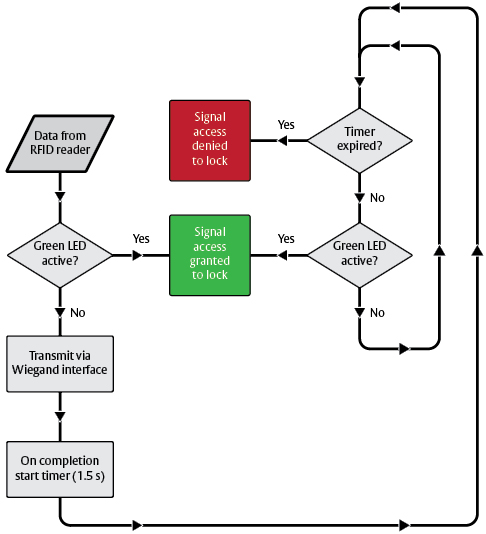
Dip Switch 1 – OFF: Access decision logic with single LED signal
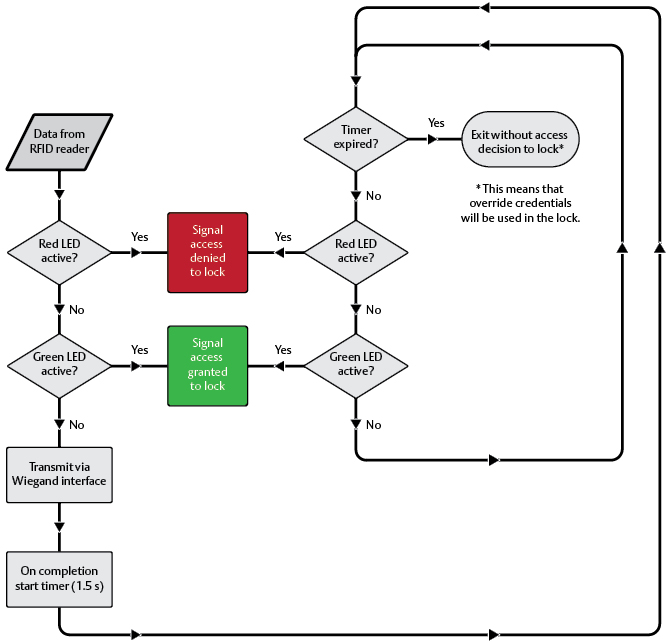
Dip Switch 1 – ON: Access decision logic with two LED signals
The communication hub must be restarted after any changes on the DIP switch, since the state of the DIP switch is read only at startup. If the EAC system is using output signal Red LED for other purposes than to control the lock, then this signal should not be connected to the communication hub. Set DIP switch 1 in position OFF in this case.
If the EAC system is using output signal Green LED for other purposes than to control the lock, then this signal should not be connected to the communication hub.
Use a lock relay output or another similar lock control output from the EAC system instead.Use of override credential is not possible if DIP switch 1 is in position OFF. The reason is that the communication hub produces an “access denied” decision based on time out in this case.